Showing posts with label ceramics. Show all posts

Tuesday, July 31, 2018

Retro-futuristic “Container’s” and the act of choosi

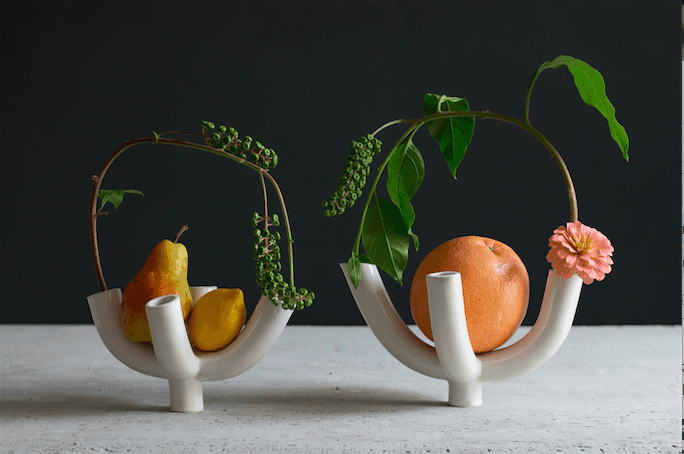
Inspired by 17th-century Dutch tulip vases, architecture, and retro-futurism, Erica Prince‘s ‘Containers‘ series features an array of ceramic vessels that inspire their users to find creative ways of utilizing them.
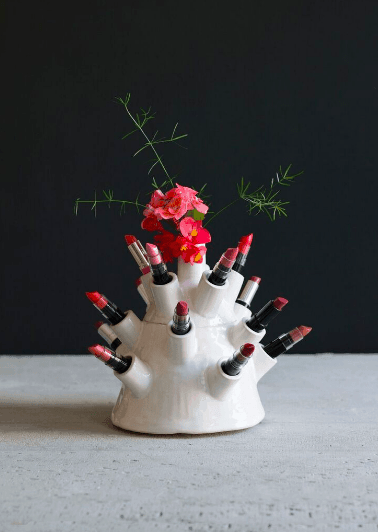
The Containers are beautiful on their own, easily passing for purely aesthetic, abstract sculptural works. However, Prince’s interest lies primarily in the way people interact with the sculptures on a functional level. Containers is a manifestation of the artist’s desire to bring awareness to the simple, meditative act of choosing and arranging objects.
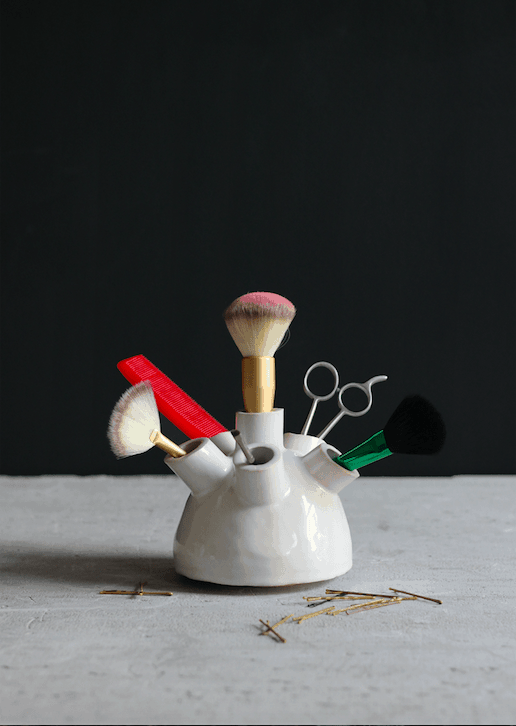
Prince’s biomorphic Containers have versatile, tube-like openings, allowing the pieces to take on the personalities of their users as they are filled with flowers, makeup, fruit, or whatever else they may be used for. Containers reflects the artist’s belief that traditionally feminine endeavors such as arranging and organizing personal items shouldn’t be viewed as superficial, but rather that these rituals can be important for self-actualization.
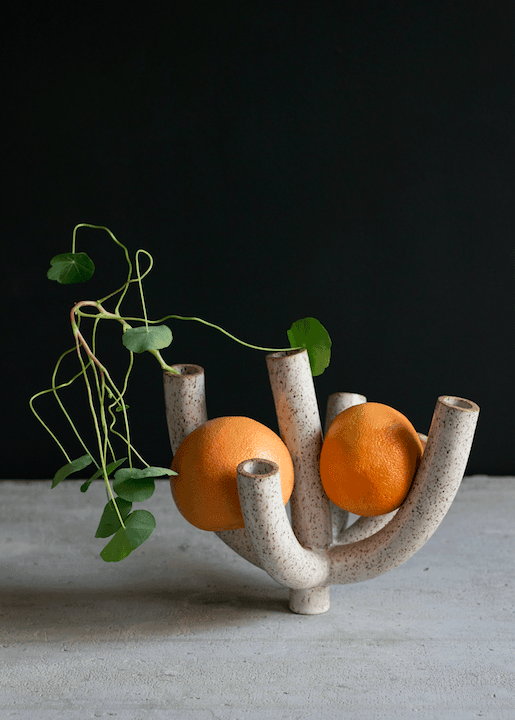
“We are surrounded by machine made objects and their perfection isn’t so special to us anymore. Handmade objects slow us down- their nuances imbue them with personality and energy, reminding us of our humanity.”
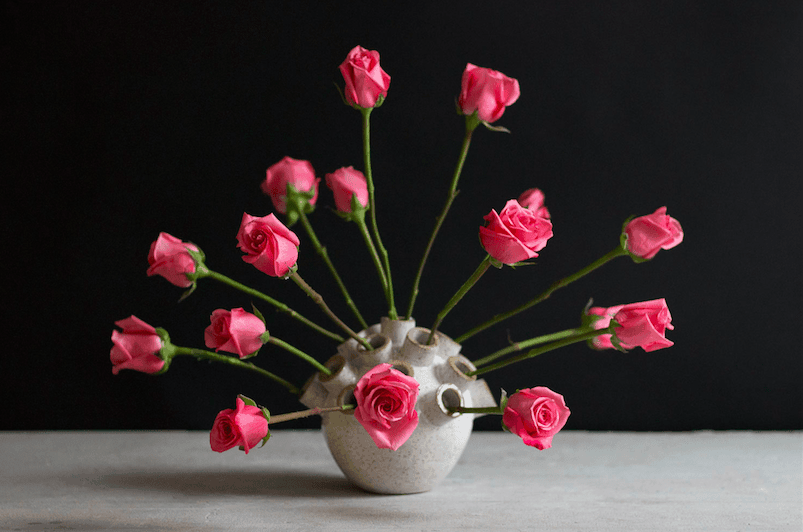
See more of Prince’s work, and read about her Transformational Makeover project at EricaPrince.com
The post Retro-futuristic “Container’s” and the act of choosi appeared first on FREEYORK.

Thursday, January 18, 2018

An Artist Creates Ceramic Sculptures That Mimic Machine Methods

Melbourne-based artist Rose Wei aka Zhu Ohmu — uses art to explore the connection between human and nature.

For the ceramicPlantsukuroi’ set, the process of the 3D printer was mimicked by hands, unveiling a unique interpretation of machine procedures.

During the 3D printing process, ceramic vessels are often stacked, folded, pressed and pulled to match programmed measurements. Contrastingly, through the more tactile medium of hand-crafting, Rose managed to make each piece with abnormalities and greater participation in the crafting process.

“Unlike the machine, I can detect the smallest change in the properties of the clay body under different ecological states,” Rose explains. “This insight into plasticity and workability, which can only be gotten by spending some time with the physical matter through play and monitoring, lets me work with and control the material. In the absence of firmware or a mechanical procedure, no two vessels may be the same — that this endeavor is a celebration of the artist’s hand at the age of automation.”

“This project is really a celebration of the artist’s hand at the time of automation.”

Rose’s lack of instruction in ceramics highlights the experimentation in her procedure — leading to the natural forms of every boat. When using these methods, Rose shows that breakage usually occurs during the last phases. Nevertheless, these imperfections are essential as the final accents. The abnormalities add a charming personality to each thing and embrace the Japanese philosophy of wabi-sabi — the acceptance of transience and imperfection. Rose describes, “Further research motivated the project to adopt the practice of kintsukuroi — the art of mending broken pottery with gold lacquer. As the title of this project indicates, vegetation is utilized instead to fill and embellish the cracks; subsequently, the functions become living organisms and will develop and grow for years to come.”

Monday, December 11, 2017

A Korean Artist Creates Creates Deliciously Glazed Ceramic Donuts

South Korean ceramicist Jae Yong Kim creates deliciously shiny donuts out of clay, glitter, and Swarovski crystals. The artificial desserts present a glossy perfection in their paint program, nevertheless contain an irregularity in shape to trick the eye into thinking they could be an edible treat.

Kim chooses patterns and images that evoke a sense of pop culture both past and current, with several pieces imitating the manner of famous painters like the splattered marks of Jackson Pollack or concentric dots of Yayoi Kusama. These implications, alongside their presentation as food, ask the viewer to think about what they are consuming when viewing his little, spherical works.

“Without my aim, references to Pop Art are a consistent occurrence throughout the entirety of this donut artworks,” said Kim in a statement. “Questioning myself concerning the donuts falling in line with a certain genre has attracted questions and demand for comprehension. Each donut has invariably read to me as a small painting; color, pattern, and physicality are the ultimate processes for my private expression.”

Kim is a graduate of this Hartford Art School and Cranbrook Academy of Art. Kim divides his time between Korea and New York, also operates kind of studio in Jersey City, NJ. You may view more of his donut-based paintings onto his Instagram, and have a peek at ceramic works on his website.

Monday, November 27, 2017

Porcelain Sculptures Closely Layered in Botanical Patterns by Hitomi Hosono

Ceramicist Hitomi Hosono creates ceramic vessels wrapped in hundreds of leaf springs and other botanical forms. These monochromatic elements are based on plants Hosono experiences during walks throughout East London’s greenery.
“It is my intention to move the leaf’s beauty and detail into my porcelain work,” she explains, using it as my own language to weave new stories for items.”

Her strategy is inspired by Jasperware, a form of stoneware coated in sparse ceramic reliefs invented by Josiah Wedgwood from the late 18th century. Like Wedgwood, she carefully applies her delicate forms to a porcelain base. From beginning to finish a more significant work will take Hosono almost a year and a half to complete. A lot of the time is invested drying, as her densely layered functions often need 10-12 weeks to completely dry.

Hosono’s solo exhibition, Reimagining Nature: Hitomi Hosono’s Memories in Porcelain, is currently on view in the Daiwa Anglo-Japanese Foundation in London through December 15, 2017. You can view more of her layered botanical sculptures on the artist’s website and via her gallery Adrian Sassoon.